Toyota- Race To Win
Client:
Toyota
Project Type: Unity Development
In 2022, I was part of a pitch for a Toyota spaces in the Ball Arena in Denver, the brief was to create a space where player could spend time between games, and immersive themselves in Toyotas space with the release of the new Rav4. We eventually landed with a core idea that was based around a Batak game, where the player would press physical buttons with light up rings as quick as possible. However with a digital twist where the user could see their progress and be scored based on how many buttons they could clear in a certain amount of time.
The gameplay was that of a endless runner styled game, with a custom physical button interface which the player would interact with. This meant a designed for modular environment that would endless draw City modules as the car progress down the track, with some post processing VFX to indicate speed. As well as Arduino Relay controller that would operate the LED rings around the physical buttons to indicate its target to press, which would be controlled by the Unity software


USB vs Numberpads
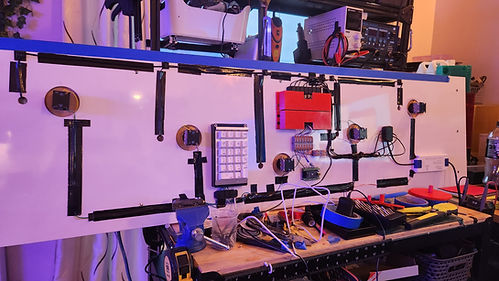
The major challenge for this job, was the combination of LED controller and the Button interfaces. After testing a range of inputs and output, I settled on a simple but effective solution to hack a USB number pad controller and wire them directly to the front facing buttons. This wouldn’t just mean quick response times, but Unity only reacting to Key presses, and could be easy debugged remotely and act as a redundancy encase the LED Microcontroller every failed.
The microcontroller is connected to unity over USB, but it operation is simply to receive a 4 letter code , that indicates which button and which turn on and off, based on the game logic in the software. This help in developed as the game logic could be worked on separately to the central unit and would mean the unity app was never waiting for a response from the controller, meaning we would push the update speed on the Arduino nano to USB


Outcome
The Job, was a massive success and was designed to last over 3 years in situ, we a remote KVM solution we was able to issue updates, fix bugs and monitor its performance. I design the button units in CAD using fusion 360 and develop a solution that would allow for spare 3d printed Nylon buttons and parts to be easily swapped out, if the wear and tear ever became too much. However after 2 and half years there been very little damage to unit, and the system still boots up and runs as expected, which gives me great confidence in the development of long term interactive installs based around some of technologies I developed for the job.